| |
|
| |
The VESTIGES Project was formed in 1984 as an ongoing, loosely-knit collective of artists and writers who share a common sense of place - New Orleans - and a common sensibility nurtured by the New Orleans environment. To VESTIGES Project participants, New Orleans signifies far more than merely a place on a map: it is an entity with a complex and eclectic culture, made up of layer upon layer of remnants, relics, rituals, memories and myths, and characterized by a hazy distinction between fiction and truth, facade and reality, past and present, that is peculiar to New Orleans. Debra Howell
|
The New Orleans Memory Project is both a repository and an investigation: of our collective memory and identity; of the influence of our culture on our memories; of the relationship between our memories and our history. We’d like this site to act as the mirror before which we assess our each-day-older selves, and to which we attach our photos, our memorabilia, our hodgepodge of disparate items we want to mark, to remember, to keep close. Hopefully, we can use the strength of our collective memories and cultural identity to effect the plans for the future of our beloved city. While VESTIGES Project artists and writers will act as moderators, this project welcomes all contributions. Anyone can respond to an entry with comments, but contributions of text, images, audio and video clips should be sent via email to admin@thevestigesproject.org
| | Pre-K | Post-K |
|
Memory (living in New Orleans)
|
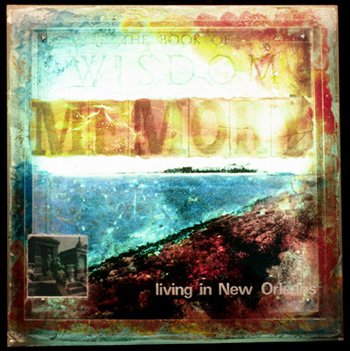
"Living in New Orleans", by Debra Howell
Panel from installation at Canal Place Cinema
Link URL:
More about the installation
|
|
|
Comments (1)
|
|
|

|
|
A street art place
|
"Growing up in New Orleans, I experienced music and dance as forms of expression that allow us to be most in our bodies, to have and own our bodies. I defined this as real freedom. I am New Orleans... I embody its culture and spirit. I look in the mirror, I dance, or I make food. It comes out when I hear my voice, I hear home. I carry this with me always and it comes through everything I do. I come from a street art place—in New Orleans, everyone is an artist. We know how to take shit and make gold. That's something I hold very close to me."
Lorna Williams, “Tree of Life: Q+A With Lorna Williams” Art in America, 9/7/2011
Link URL:
Link to full article in Art in America
|
|
|
Comments (0)
|
|
|
|
|
|
New Orleans, Mon Amour
|
Andrei Codrescu opens New Orleans, Mon Amour, Twenty Years of Writings from the City by popping the question: “How did we fall in love? At first sight, violently.” “Later, when I started living there, I caught the Mythifying-of-New Orleans virus, too. The city that Mark Twain called “the upholstered sewer” generated stories like water from a faucet left on everywhere you looked."
Andrei Codrescu, New Orleans, Mon Amour, Twenty Years of Writings from the City, Algonquin Books of Chapel Hill 2006.
|
|
|
Comments (0)
|
|
|
|
|
|
Earth/Water/Other
|
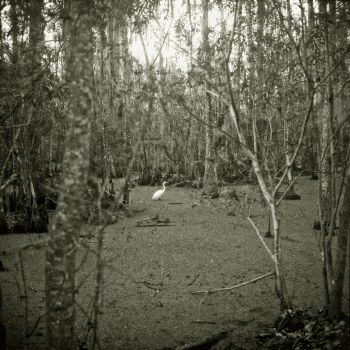
"It is a place that seems often unable to make up its mind whether it will be earth or water, and so it compromises," wrote Louisiana historian Harnett T. Kane in The Bayous of Louisiana. “The result is that much of Louisiana belongs to neither element. The line of demarcation is vague and changing. The distinction between degrees of well-soaked ground is academic except to one who steps upon what looks like soil, but finds that it is something else.”
|
|
|
Comments (0)
|
|
|
|
|
|
William Greiner: Pre-K
|
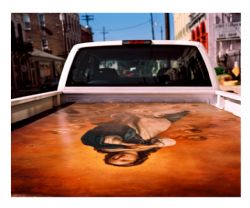
Many of you are accustomed to receiving , almost, weekly emails of recent images I have made. Well, I haven’t made a whole lot since Katrina. I just haven’t had the heart or desire! It has been at least six weeks since I fled New Orleans. I have been back but it’s not what I left. These pre-K New Orleans images , which you may know, now seem to resonate with a different meaning.
Photos by William Greiner
Link URL:
William Greiner's photo blog
|
|
|
Comments (0)
|
|
|
|
|
|
Art Lost to Katrina
|
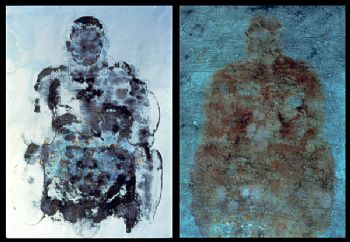
"Selected Fictions Comprise a Peculiar Reality" #8 and #35 by Debra Howell; Lost on Onyx Street
|
|
|
Comments (0)
|
|
|
|
|
|
Time in odd moments.
|
The dense layers of New Orleans' ongoing milieu create a world in which the senses are easily overwhelmed: sound and color and words collide with and blend into one another; emotions are hard to discern, because one is at pains to conceal one's deepest responses and present a carefree face. Assemblages of words and objects and materials are hammered out that convey the sense of the New Orleans within-- the dynamic processing of experience that is the constant activity of the self-- comprised of memory, people, objects, streets, houses, sounds, smells. New Orleans' inhabitants are among the most self-assured people in the New World, largely because they assimilate without question a culture whose whole fabric (both strengths and flaws) appears as "givens". It is not always clear what is being built up and what is breaking down-- which resembles the floating, isolated moment that New Orleans seems perpetually to exist in spiritually, while the real-world process of birth and decay goes on busily nonetheless.
By poet Carolyn Maisel, from "Contemporary Memorials" catalogue
|
|
|
Comments (0)
|
|
|
|
|
|
How did/do/will/should we remember?
|
Memorials provide an unending source of fascination. This is not only unique to Berlin, a city whose history is so contentious—in terms of its past conflicts as well as the interpretation of that past—but is evident in just about every place where people have ever lived (I imagine).
For any culture, society, or community, there is always so much at stake with the memorials it creates, as if there was only one chance to mark the memory of the past with one grand gesture of finality: “This happened here, and this is how we remember it. Forever and ever.” Every memorial is bound to questions of representation and symbolism—who is represented? what is symbolized?—and ultimately to the question of authority—who decides how the past is represented and how a group’s values are symbolized? And then, an architect or an artist (or groups of these) is commissioned with the task of creating something which embodies all of these unfixed and imprecise ideas and psychologies of remembrance in one final gesture. Once you begin to look a bit deeper at a memorial and the process of its becoming, you can learn so much about a place and its citizens and its (contested) notion(s) of itself.
J. Beaudry
Link URL:
About Place in Place of: Berlin
|
|
|
Comments (0)
|
|
|
|
|
|
Street Names
|
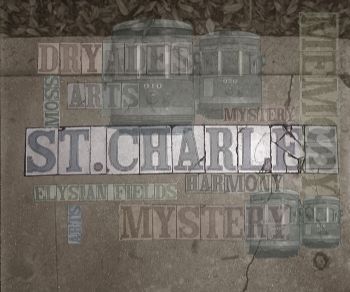
"New Orleans Streets", by Debra Howell
|
|
|
Comments (0)
|
|
|
|
|
|
Social Memory
|
I believe that the importance of personal memory, made up collectively as local, or even national memory, has only begun to be realised by social historians, some of whom now write of "social memory" or "popular memory." It is appropriate that we connect the two terms "memory" and "mythology" and it is appropriate also to visit questions concerning their interconnectivity.
In France, Pierre Nora's pioneering work, Les Lieux de Memoire, unhappily translated into English by his American publishers as "Realms of Memory," provides a framework for any historian wishing to study the relationship between history, memory and their cultural reference points--images, sounds, institutions, memorials, buildings, texts and the many other iconic forms with which nations and peoples surround themselves in an attempt at self-identification. These are, after all, the memoria technica of the human mind and the human experience.
Bob Bushaway, Department of Modern History, University of Birmingham, UK
|
|
More
|
Comments (0)
|
|
|
|
|
|
|
Waterwords
|
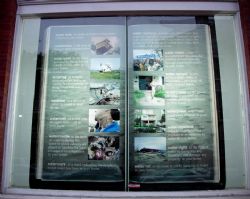
A photolightwork collaborative installation by Debra Howell & Jan Gilbert, August 29, 2006 (detail)
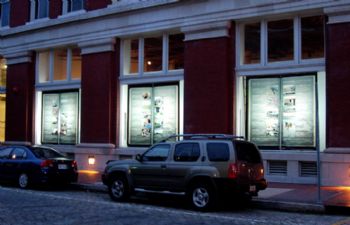
Installation view of Waterwords at the Contemporary Arts Center, 2006
This “Katrina Pictionary” plays on the linguistic phenomenon in which a word’s importance in a culture is reflected in the number of variations of it that exist in the cultural lexicon. The possible result of whiling away the hours of, say, an evacuation by playing parlour games, these “pages” of waterwords and images mimic both the traditional game of “Pictionary” and the somewhat sillier game of "Fortune Cookie" whereby you are required to insert the words “in bed” after every statement read by the players. Here, the game addresses the flood-related losses of so many with the hope of softening the sorrows with wordplay and image.
Update, September 2007. Waterwords is now available for purchase as an archival lightjet print. Click here for details
|
|
|
Comments (0)
|
|
|
|
|
|
Lexicon by Jan Villarrubia
|
The culture of New Orleans is a rich mingling of many diverse ethnicities, spiritualities, communities, attitudes, rituals and traditions. Not only have New Orleanians developed their own food and music, the people also speak a different language from the rest of the United States. The following is a list of terms explained in a manner to provide insight into the universe that is New Orleans...
“Burn K-Doe Burn” Shots is kind of a long story. Native New Orleanian Ernie K-Doe, Ernest Kador, Jr., February 22, 1936 - July 5, 2001, “the one, the only, the baddest motorscooter and the Greatest Boy-Child ever conceived at Charity Hospital in New Orleans, Louisiana” (according to the official website www.k-doe.com), shot to fame in 1961, when his song “Mother-in-Law,” written by New Orleanian Allen Toussaint, climbed to No. 1 in the nation and sold millions. K-Doe, also an accomplished drummer, recorded other rhythm and blues hits like "A Certain Girl", "T'ain't It the Truth", "Come On Home", "Te-Ta-Te-Ta-Ta" and "Later for Tomorrow" and years later “White Boy, Black Boy." "Mister Naugahyde,” as he billed himself in the 1980s on local radio shows, used catch phrases like "Burn, K-Doe, Burn!", "I'm a Charity Hospital Baby!" and “I’m cocky, but I’m good!” In the ‘90s, the energetic showman began wearing a crown and cape and calling himself “Emperor of the Universe.” He opened his Ernie K-Doe Mother-in-Law Lounge in 1994, 1500 N. Claiborne Avenue, New Orleans and, in 1996, married Antoinette Fox who became a legend in her own right. Often, K-Doe himself would meet you at the door of his bar and music club where he and other living legends of New Orleans performed. The signature drink there was called Burn K-Doe Burn, containing cherries and a highly potent distilled grain-alcohol.
|
|
More
|
Comments (0)
|
|
|
|
|
|
"a testament to how men dreamt land out of water"
|
So, when the strong unholy high winds whiplashed over the sold-off marshlands eaten back to a sigh of saltwater, the Crescent City was already shook down to her pilings, her floating ribs, her spleen & backbone...
Excerpt from Requiem by Yusef Komunyakaa, Oxford American, Issue 51, Fall 2005
Link URL:
Link to full text of poem "Requiem".
|
|
|
Comments (0)
|
|
|
|
|
|
New Orleans Culture
|
"New Orleans always understood far better than more so-called sophisticated cities that culture is experience, not product." Annette Carlozzi, “In Katrina’s Wake, An Exhibition/Report/Call to Leadership,” Art Lies, Issue 58, Workspace 08
Link URL:
Link to Article
|
|
|
Comments (0)
|
|
|
|
|
|
Streets as Storytellers
|
"The conflicting spirits of eccentricity, despair and carnival permeate the psychogeography making streets storytellers and wrecked homes witness to a full range of human experience." Dr. Lori A. Kent, “Emerging Resistance: New Orleans Psychogeography as Constructed through Memory-based Visual Arts, Cultures in Resistance,” The 7th Conference of the Discourse, Power, Resistance Series, 18-20 March 2008, Manchester Metropolitan University, UK
Link URL:
Link to Abstract
|
|
|
Comments (0)
|
|
|
|
|
|
"Crying Houses" by Krista Jurisich
|
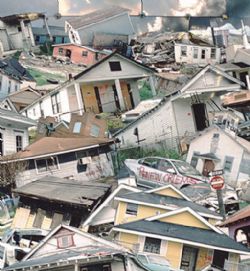
From the Mortelles series, art quilts of photo and fabric pieces showing fast-disappearing images of New Orleans.
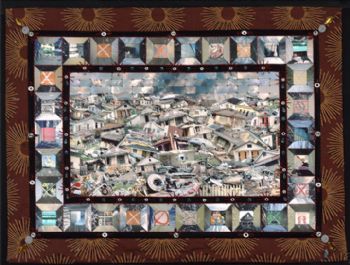
Detail (top image) and full view (bottom image)
|
|
|
Comments (0)
|
|
|
|
|
|
William Greiner: Post-K
|
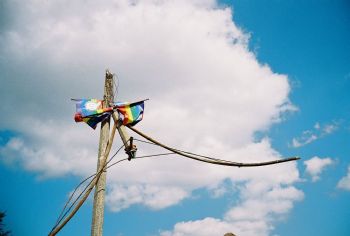
"New Orleans Street Light, October 2005" by William Greiner
Photos by William Greiner
Link URL:
William Greiner's photo blog
|
|
|
Comments (0)
|
|
|
|
|
|
Neil Alexander: New Orleans in the Aftermath
|
While many in the Crescent City rushed to escape Katrina's advancing winds, Neil Alexander, a local architectural photographer, remained battened down in his house near Coliseum Square.
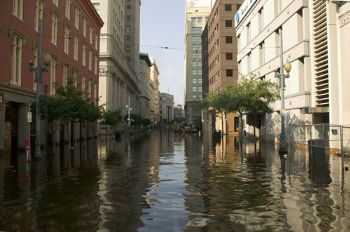
In this section on the Architectural Record, Alexander not only presents his images but also recounts for us the days after the storm. (Click on the Link URL to see a slide show with narration or the images alone)
Images by Neil Alexander
Link URL:
Neil Alexander in Architectural Record
|
|
|
Comments (0)
|
|
|
|
|
|
Tom Piazza: Why New Orleans Matters
|
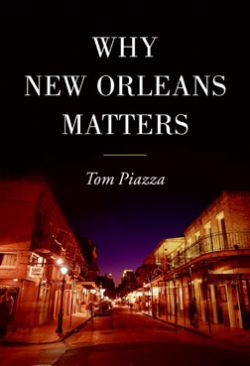
Every place has its history. But what is it about New Orleans that makes it more than just the sum of the events that have happened there? What is it about the spirit of the people who live there that could produce a music, a cuisine, an architecture, a total environment, the mere mention of which can bring a smile to the face of someone who has never even set foot there? What is the meaning of a place like that, and what is lost if it is lost?
From the Harper Collins website
Link URL:
Harper Collins
|
|
More
|
Comments (0)
|
|
|
|
|
|
Eden Gass: Funerary Banner for the City of New Orleans
|
Funerary: (fyoo'ne'rer'e) adj. Of or appropriate for a funeral or a burial. Sorrowful: mournful.
.JPG)
"Funerary Banner for the City of New Orleans" by Eden Gass
The New Orleans Funerary Banner was a 7 foot by 5 foot flag created by Eden Gass in the wake of hurricane Katrina.
Link URL:
Read more about the Funerary Banner
|
|
More
|
Comments (2)
|
|
|
|
|
|
|
|


)
)
)
)
)
)
)
)
)
)
.JPG','','width=495 height=360',''))